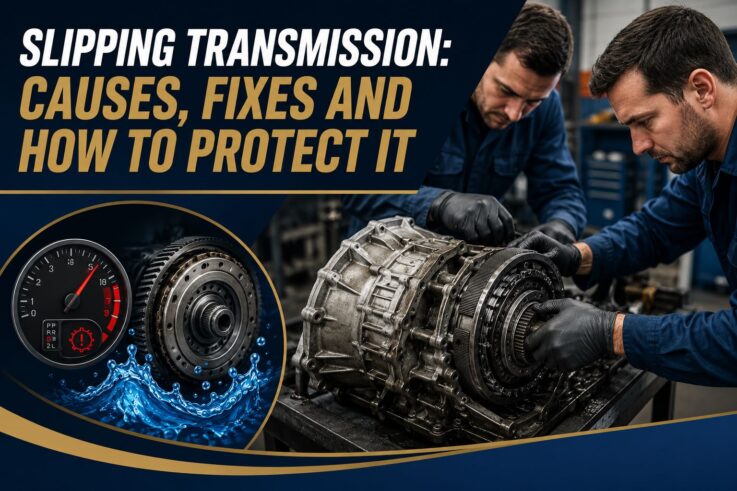

A slipping transmission is one of those automotive problems that can begin with a symptom so subtle that a driver barely notices it. Maybe the engine revs a little higher than usual before the vehicle accelerates. Perhaps there is a slight hesitation when you pull away from a traffic light. You might notice the transmission seems to shift unexpectedly while driving or that the vehicle doesn’t respond as quickly when you press the accelerator.
These symptoms should not be ignored.
Your vehicle’s transmission is responsible for transferring power from the engine to the wheels while selecting the appropriate gear for your speed and driving conditions. When a transmission begins slipping, that transfer of power is no longer happening as efficiently as it should.
Sometimes the cause is relatively straightforward, such as low transmission fluid. In other cases, slipping can indicate worn internal components or another problem that requires professional diagnosis.
Understanding the warning signs — and responding to them early — can sometimes mean the difference between a manageable repair and replacing or rebuilding a transmission.
What Does It Mean When a Transmission Is “Slipping”?
Transmission slipping generally refers to a situation in which the transmission is unable to remain properly engaged in the appropriate gear or isn’t transferring engine power to the wheels efficiently.
One of the most recognizable symptoms occurs when you press the accelerator and the engine RPM rises significantly, but the vehicle doesn’t accelerate at the rate you would expect.
It can feel almost as though the engine and wheels are temporarily disconnected.
Depending on the type of transmission and the underlying problem, slipping may occur while accelerating, when changing gears, after the vehicle warms up, or only under heavier loads such as climbing a hill.
A slipping transmission should not be considered normal wear that you simply have to live with. It is a symptom that needs to be investigated.
Common Signs of a Slipping Transmission
Transmission problems don’t always announce themselves with a dashboard warning light. Drivers should pay attention to changes in the way their vehicle feels, sounds and responds.
Common warning signs include:
- Engine RPM increases without a corresponding increase in vehicle speed
- Hesitation before the vehicle begins moving
- Delayed engagement when shifting from Park into Drive or Reverse
- Unexpected or unexplained gear changes
- Rough, abrupt or unusually hard shifts
- Difficulty accelerating
- Transmission seems to fall out of gear
- Burning smell
- Unusual whining, humming or clunking noises
- Transmission fluid leaking beneath the vehicle
- Check Engine or transmission warning light
- Poor performance when driving uphill
- Changes in normal shift points
If you’re experiencing several of these symptoms, having the vehicle inspected by an Auto Mechanic in Astoria can help determine whether the transmission itself is failing or another component is causing similar symptoms.
What Causes a Transmission to Slip?
There isn’t one single cause of transmission slipping. Modern transmissions contain hydraulic, mechanical and electronic components that all have to work together correctly.
Here are some of the most common causes.
- Low Transmission Fluid
Low fluid is one of the first things that should be investigated when an automatic transmission begins behaving abnormally.
Automatic transmission fluid performs several important functions. It lubricates components, helps remove heat and, importantly, provides the hydraulic pressure the transmission needs to operate.
If the fluid level becomes too low, the transmission may not have sufficient hydraulic pressure to properly engage its internal components.
But simply adding fluid isn’t necessarily the solution.
Transmission fluid doesn’t normally disappear. If the level is low, there may be a leak from a transmission pan gasket, seal, cooler line or another component. The source of the leak should be identified and repaired.
- Old, Contaminated or Overheated Transmission Fluid
Transmission fluid deteriorates over time.
Heat is one of a transmission’s biggest enemies. Repeated exposure to high temperatures can degrade the fluid and reduce its ability to lubricate and protect internal components.
Healthy transmission fluid is generally clean and has a characteristic color appropriate to the manufacturer’s fluid specification. Fluid that is extremely dark, contaminated or smells burnt can be a warning sign.
However, transmission fluid condition should be evaluated along with the manufacturer’s service requirements. Not every transmission uses the same fluid, and service procedures differ considerably among vehicles.
- Worn Clutch Packs
Automatic transmissions use internal clutch packs to engage different gear combinations.
Over time, friction material can wear. If a clutch pack can no longer hold properly, it may slip under load.
This can produce the classic symptom of rising engine RPM without a proportional increase in vehicle speed.
Internal clutch wear is considerably more serious than simply correcting a low fluid level and may require substantial transmission repair.
- Torque Converter Problems
The torque converter transfers engine power into an automatic transmission and allows the vehicle to remain stopped while the engine continues running.
A failing torque converter or torque-converter clutch can cause symptoms including shuddering, slipping, overheating or unusual changes in engine RPM.
Because torque converter symptoms can overlap with other transmission problems, proper diagnosis is important before replacing components.
- Solenoid or Valve Body Problems
Modern automatic transmissions depend heavily on hydraulic controls and electronics.
Shift solenoids regulate the flow of transmission fluid through various passages. The valve body directs hydraulic pressure to the appropriate parts of the transmission.
A malfunctioning solenoid, restricted hydraulic passage or valve-body problem can interfere with gear engagement and produce symptoms that feel like mechanical transmission failure.
This is one reason diagnosis should come before assuming the entire transmission needs replacement.
- Electronic and Sensor Problems
Today’s transmissions communicate with the vehicle’s computers and depend on information from numerous sensors.
A faulty speed sensor, wiring problem, control module issue or another electronic fault can affect transmission operation.
The diagnostic trouble codes stored in the vehicle’s computer can provide valuable clues, but a code by itself does not necessarily identify the failed component. It is the starting point for diagnosis, not always the final answer.
- Excessive Heat
Transmission heat can increase significantly during demanding driving conditions.
Heavy stop-and-go traffic, towing, carrying heavy loads and driving during extremely hot weather can increase transmission temperatures.
When excessive heat becomes chronic, fluid can deteriorate faster and internal transmission components can suffer accelerated wear.
Can You Keep Driving With a Slipping Transmission?
It isn’t a good idea.
A transmission that slips occasionally today may become significantly worse tomorrow. Continuing to drive can generate additional heat and accelerate wear to already compromised components.
There is also a safety consideration.
If you pull into traffic expecting normal acceleration and the transmission suddenly fails to deliver power properly, the vehicle may not respond the way you expect.
If your transmission is slipping, arrange for Transmission repair in Astoria or a professional diagnosis as soon as practical rather than waiting for the problem to become severe.
How Is a Slipping Transmission Diagnosed?
Good transmission diagnosis is a process, not a guess.
A technician may begin by asking when the problem occurs. Does it happen when the vehicle is cold or only after warming up? Does it happen during a particular gear change? Is it worse when accelerating hard or climbing hills?
That information can be extremely useful.
Depending on the vehicle and symptoms, diagnosis may include checking:
- Transmission fluid level and condition
- Evidence of external fluid leaks
- Diagnostic trouble codes
- Live sensor and transmission data
- Transmission operating temperature
- Electrical connections and wiring
- Shift solenoid operation
- Hydraulic pressure
- Road-test behavior
- Engine-related problems that could mimic transmission symptoms
A qualified Auto Mechanic in Queens should look at the entire system rather than immediately assuming the transmission needs to be replaced.
Does a Slipping Transmission Always Need to Be Rebuilt?
No.
The repair depends entirely on what is causing the slipping.
A transmission leak may require replacing a seal, gasket or damaged line and correcting the fluid level. Some problems may involve a sensor, solenoid or valve-body component. Other situations may require torque converter repair or replacement.
If internal friction components have become severely worn or damaged, however, rebuilding or replacing the transmission may be necessary.
Early diagnosis gives you the best chance of addressing a smaller problem before additional damage occurs.
When choosing a Car repair shop in Astoria, look for technicians who will diagnose the cause of the problem rather than simply recommending a major repair based on symptoms alone.
Transmission Maintenance: What Drivers Can Do
The best transmission repair is often the one you can prevent.
While no maintenance program can guarantee that a transmission will never fail, several habits can improve its chances of delivering a long service life.
Follow the Manufacturer’s Maintenance Schedule
Transmission service intervals vary widely.
Don’t assume that a service schedule appropriate for one vehicle applies to another. Follow the manufacturer’s recommendations for your particular year, make, model, engine and transmission.
Use the Correct Transmission Fluid
Transmission fluids are not interchangeable simply because they look similar.
Modern transmissions may require very specific fluid formulations. Using an incorrect fluid can affect lubrication, hydraulic performance and shift quality.
Always use fluid that meets the manufacturer’s specifications.
Don’t Ignore Leaks
A few drops of fluid on the driveway can turn into a serious problem.
If you notice fluid beneath your vehicle, have the source identified. A small leak that is repaired early may prevent the transmission from operating with dangerously low fluid later.
Pay Attention to Changes in Shifting
Drivers become accustomed to how their vehicles normally behave.
If your vehicle suddenly begins shifting harder, hesitating, shuddering or behaving differently, don’t ignore it simply because it still drives.
Changes are often your vehicle’s way of telling you something needs attention.
Be Mindful When Towing
Towing places additional demands on the engine, cooling system, brakes and transmission.
Never exceed the manufacturer’s towing limits. Vehicles that tow regularly may also have different maintenance requirements.
Don’t Abuse the Transmission
Come to a complete stop before shifting between Drive and Reverse.
Frequently shifting direction while the vehicle is still moving puts unnecessary stress on transmission components.
Similarly, aggressive acceleration and repeated hard launches can increase heat and mechanical stress.
Regular maintenance at a reputable shop providing auto repair in Astoria can also identify leaks and other developing problems during routine inspections.
What About Electric Vehicles? Do EVs Have Transmissions?
This is an increasingly important question because electric vehicles operate very differently from conventional gasoline-powered cars.
Most EVs do not have a traditional multi-speed automatic transmission like the one found in a gasoline vehicle.
The reason is largely related to the characteristics of an electric motor.
Internal-combustion engines operate efficiently over a comparatively limited RPM range. They therefore need multiple gear ratios to keep the engine operating effectively as vehicle speed changes.
Electric motors can deliver strong torque from very low speeds and operate efficiently across a much broader range of RPM. Consequently, many EVs use a single-speed reduction gearbox rather than a conventional multi-speed transmission.
The electric motor turns at high speed, and the reduction gearing converts that output into an appropriate wheel speed and torque.
There are exceptions. Some electric vehicles use multi-speed arrangements, particularly when manufacturers are trying to optimize acceleration, efficiency or high-speed performance. But the single-speed reduction drive remains common.
Can an Electric Vehicle Have a “Slipping Transmission”?
Not usually in the traditional sense.
Because most EVs don’t use the same type of hydraulic automatic transmission with multiple clutch packs and gear changes, the classic transmission-slipping symptoms associated with gasoline vehicles generally don’t apply in the same way.
That does not mean an EV’s drivetrain is maintenance-free or incapable of developing problems.
An EV can experience issues involving:
- Reduction gears
- Bearings
- Drive-unit lubrication
- Axles and CV joints
- Electric motors
- Motor control electronics
- Cooling systems
- Seals and fluid leaks
- Software and electronic controls
An EV that hesitates or suddenly loses power may therefore have a completely different problem from a gasoline vehicle exhibiting what appears to be a similar symptom.
Do EV Transmissions Need Fluid?
Many electric drive units do contain specialized lubricants or fluids.
Even though an EV may not need conventional automatic transmission fluid in the traditional sense, gears and bearings still need lubrication. Some electric drive units also have specialized thermal-management requirements.
The crucial point for EV owners is not to assume that conventional transmission maintenance procedures apply to an EV.
Always follow the manufacturer’s specified service procedures and fluid requirements.
Some EV drive units may require little routine service, while others may specify fluid inspection or replacement under particular conditions or intervals.
If you are in the NYC area, a shop performing Auto repair in Queens can verify the requirements for the specific EV rather than treating its drive unit like a conventional automatic transmission.
EV Transmission and Drive-Unit Care
If you own an electric vehicle, there are several sensible precautions.
First, follow the manufacturer’s maintenance schedule. The absence of an internal-combustion engine does not mean the entire vehicle is maintenance-free.
Second, don’t ignore unusual noises. Whining, grinding, clicking or humming that wasn’t previously present can indicate a bearing, reduction gear, axle or other drivetrain problem.
Third, have fluid leaks investigated. An EV should not be leaking drivetrain fluid simply because its drive system is different from a conventional car.
Finally, cooling systems matter enormously in electric vehicles. EVs rely heavily on thermal management for the battery, power electronics and, depending on the design, drive-unit components. Manufacturer-specified coolant and thermal-management service should not be ignored.
A Transmission Problem May Not Actually Be the Transmission
One of the biggest mistakes a vehicle owner can make is diagnosing the vehicle based only on how the problem feels.
For example, poor engine performance can sometimes resemble transmission hesitation. An ignition or fuel-delivery problem may cause poor acceleration. A failed engine or transmission mount can make normal shifts feel abnormally harsh. Electronic throttle problems can change acceleration response.
In an EV, a power-delivery problem might originate in the electric drive system, battery management system, inverter, electronic controls or another component rather than the reduction gearbox itself.
Professional diagnosis is therefore essential before expensive parts are replaced.
What Should You Do at the First Sign of Transmission Trouble?
Pay attention to exactly what the vehicle is doing.
Notice whether the problem occurs when the vehicle is cold, hot, accelerating, slowing down or climbing a hill. If possible, note which speeds or driving conditions cause the symptom.
Check your parking space for evidence of fluid leaks.
If a warning light appears, don’t simply clear it and continue driving without determining why it came on.
Most importantly, don’t wait until a small drivability issue becomes a major failure.
If you are in the NYC area, a professional Auto Mechanic in Astoria can inspect the vehicle, retrieve diagnostic information and determine whether the problem is related to fluid, electronics, hydraulic controls, internal wear or something outside the transmission entirely.
The Bottom Line: Don’t Ignore a Slipping Transmission
Your transmission is one of the most complex and expensive mechanical systems in a conventional vehicle. Protecting it starts with proper maintenance and paying attention when the vehicle begins behaving differently.
If the engine suddenly revs without the vehicle accelerating normally, shifts are becoming delayed or harsh, the vehicle hesitates before moving, or you notice leaking transmission fluid, have the problem diagnosed promptly.
Sometimes the solution can be relatively straightforward. Other times, the symptoms indicate internal wear that requires more extensive repair. Either way, continuing to drive and hoping the problem disappears is rarely a good strategy.
Electric vehicle owners should take a similar approach, while recognizing that most EV drivetrains are fundamentally different from conventional automatic transmissions. Their reduction gearboxes, motors, bearings, lubricants and thermal-management systems still require proper inspection and manufacturer-specified care.
For drivers looking for professional auto repair in Astoria, choosing technicians who diagnose the underlying cause before recommending repairs is especially important when dealing with transmission and drivetrain problems.
Whether you drive a traditional gasoline vehicle, hybrid or EV, the principle is the same: listen to your vehicle, maintain it according to the manufacturer’s specifications and address unusual symptoms early.
If you live in the New York area and you suspect a transmission or drivetrain problem, Steinway Auto Repair can inspect your vehicle, determine the source of the symptoms and explain the appropriate repair options. Whether you need routine maintenance, Car repair shop in Astoria services, or specialized Transmission repair in Astoria, catching problems early can help prevent a relatively manageable issue from becoming a much more expensive repair.
The above content does not constitute advice for your individual vehicle, but is presented for informational purposes only. If your vehicle is having any issues, then seek the help of a professional mechanic.


